
by Lancelot Schaubert
“Mert,” her boss called. Meredith muttered under her breath, pouted, and sulked as she peeled her eyes away from the screen. Lightyears from their homeworld, and still they depended on spreadsheets and spare parts bought from the lowest bidder. She absent-mindedly fidgeted through all of it on her quick keys.
“Mert.” Her boss called again.
Meredith’s boss was an old toad of a woman, as if some beautiful young girl had been squeezed like toothpaste into the military’s steel slag mold and left to rot. Stuff grew on the woman’s nose. Not-nose-yet-growing-on-nose stuff.
“Yeah?” Meredith snapped, her faithfully extremely frizzy long grey hair slinkying. She’d tamed it yet again that morning with her systematic treatment of dreamsickle-scented shea butter cream. She’d disguised her face with a similarly systematic application of makeup as well as the teardrop silver earrings she’d found in the wholesale supply chain of some obscure backend jewelries. Tingling sounded from those earrings as a counterpoint to her voice snapping. Those chimes made her regret her snap.
Her boss said, “Just cause you can’t be bothered don’t mean I won’t bother you still. It don’t mean you aren’t needed elsewhere. We have another on-the-ground problem. Big one. Bad one. Walk with me.”
The two women left the office of various supply chain engineers, systems engineers, and civic engineers. Meredith walked past the various types of specialists, ticking off her own training in each branch. Now she spent most of her time on the phone with spreadsheets pulled up in front of her, nursing a softly toned martyr complex. How the whole station hadn’t collapsed a decade ago baffled her, and she often found herself hanging around after hours, loitering in case somebody — anybody — would stop by the water cooler to share their gratitude for how she kept the whole sack of bolts from rapid deep space decompression.
“We have a huge problem, Mert,” her boss said.
“A hundred,” Meredith said. “Those quartz geodesics from Attech—“
“No,” her boss said. “Here. Now. Right now. HUGE. People are freezing to death!”
Dammit. Yet one more difficult job she’d have to take to prove her competency. Meredith didn’t want to give them all one more reason to call her Mert. She shook the images from her head and walked with her eyes cast on the floorboards. And then she hated herself, that was how she felt. The shame woke her to a deeper sadness. That sadness settled on her brow, a deflated cake. “Do you know how hard I’ve worked?”
“I both know and don’t care for this kind of emergency.”
“What do you mean?”
“Heating system went haywire. Cold is seeping in everywhere. Everywhere! It’s turned sections of the ship to icicles and frozen tundra.”
Wow. That… that was… actually a major disaster. Like act of devil level emergency. “What do you mean?” Meredith asked again.
Her boss pointed as they walked to one of the mini-malls embedded into the various passageways on the station: junk cinnamon rolls, ATMs for portable crypto wallets, a line going into the home gadget store. A massive line emerging with blankets. “Folks are freezing left and right.”
Meredith barely heard her boss, uncomfortable that the woman was paying closer attention to her than to what had caught her own eye. “Mom?”
Her ninety-year-old mother was knitting while shuffling as a hovercart carried out her order of three more space heaters. “Too cold, Meridith. It’s just too damn cold.”
She gently grabbed her mother’s shoulders. “Mom. Are you okay?”
Her mother grimaced. “I’ll be fine. I’ll be fine; I always survive.” She nodded back to the others. “Take care of them. You own me a breakfast. A brunch!”
“Owe you.” She squeezed the life out of her lips, each one trembling in a kind of rage. Had the woman forgotten who paid her bills?
“That’s what I said, dear.”
So she hadn’t seen her mother in weeks! Maybe a month. She felt awful about that, especially now. “Sorry,” she said. “I’ve been so busy cleaning up after the messes all the civilians who simply live here make.”
Her mother missed the barb.
Others in line didn’t, and some shouted, “Hey! We didn’t do this!”
Meredith said, “How’s the blanket?”
“I’ve knitted four,” she said. “Nothing to do, Meri, and it’s so damn cold.” Her mother pointed. Her hovercart swept away towards the corridor that led to her quarters.
Meredith looked back to her boss.
Who shook her head and said, “See?”
“How many supply stores are like this?”
“All of them.”
“All?” Meredith asked, stepping back from her boss. “All? Our ship is—”
“I’m telling you, it’s either an attack or something went haywire. The deep cold of space is leaking in from the lower floors to the top.” They were currently near the top of the station, her mother on the top floor near the command deck. Her boss pulled up a schematic on her handheld. “There’s the radiator room to check: the boiler, the rest. There’s potentially a breach somewhere in a wet wall or some place we don’t easily see.”
She flinched. “That would depressurize us.”
“Well, hell, Mert, I know that, but you got any other ideas?”
Meredith lifted both hands, palms out towards her boss, and licked her lips before she asked, “Could someone be siphoning heat some way? Energy to power… something?”
Her boss eyed her. “Did you know about that theory?”
She blushed. “What theory?”
Her boss said, “Never mind. Just find the source.”
A loud lioness breath snorted out of Meredith’s nose. “What theory?”
Her boss tossed the whole handheld to her. Then she threw her own clearance badge that would give her whatever equipment and passage she needed. Unburdened, her boss shrugged. “What you said, just… gossipy speculation. Someone inside siphoning. Get to looking.” She turned away and then turned back. “Or it’s your blood and mine.” Then left.
Meredith looked everywhere at the chaos. Yes, a natural disaster. Or unnatural. Blinking overtook her, faster, faster, then all at once gave way to something wide-eyed and blinkless. “They’ll think it’s a murder case,” Meredith said. “They always do on stuff like this.”
“Until they don’t,” her boss would have said over her shoulder, but she was already gone.
Meredith hated leaving her office. She preferred the comfort of blandness, only crappy office chairs and white imaginary boxes that auto-tallied numbers provided. But sometimes you had to see the gear and equipment with your own eyes if you wanted to find an entire line of Air Force grade nuts the factory had replaced with death cannons or a model of spring pins with a kink in the metal. Root cause, corrective action.
That’s the first thing they taught you: the symptom is where the engineering ends. But the cause of the symptom always lies further upstream. People freezing to death in the bottom was the symptom: no heat. An awful symptom. How to diffuse it? Worse than losing a limb — unless the body was the body politic of the entire ship. In that case, the entire ship would grieve until even the grievers died. The ship itself had betrayed her.
But it could be something as stupid as a tiny busted steam valve in the boiler room. Meredith didn’t want to leave her office, but she leaned away from it as if it had bitten her. The leaning got her going, got her moving in her excessive swallowing towards the boiler room.
In the elevator, she could feel the cold creeping in. The elevator stopped halfway through the floors, halfway to where she wanted to go, and the doors opened upon an entire strike team suited up for deep space. Her mouth went dry as if all the water inside had sublimed.
“Security clearance only, Murder Meredith,” the sergeant said as he ushered his men into the service elevator. They looked ready for war, ready to do something, and also — as young — dreadful that they had something to do.
Meredith held out her badge. “If you insist, Mert’s fine.”
“What the hell do we need a civic engineer for? This is an invasion, not one of your cases.”
Meredith wagged a finger and cocked her head. “Says who?”
Sergeant shrugged. “Why else would they call us?”
She did not leave, offered a fake smile, and forced herself to say in an even tone, “They call everybody when things go really, really wrong.”
“Why would they do that?” Sergeant asked.
“Maybe because they don’t know what went really, really wrong?”
“Oh. Still, civic?”
Meredith shrugged and calmly said, “You flatter even me. I’m just using the boss’s badge. I’m just a supply chain engineer.”
He scoffed at her, nodded, then said, “Suit up. It’s colder than the backside of a space witch’s tit on top of an ice—“
Slashing her hand across his personal space to the side in a slashing motion, Meredith set her jaw and said, “I get it.”
“Cold as outside.” He tried again by clearing his throat awkwardly. “Murder—”
“Mert’s fine, I guess, though plain Meredith is better.” She’d been raising her voice as she paced. “I’ll suit. Hold the lift.”
The sergeant gave her a distasteful look and said, “Catch the next one, Supply,” and took down twenty men while ten more suited up. Including Meredith. Her breath quickened, and a knot formed in her stomach. Why was she standing sideways in the hall?
As if her body had already shielded itself from that man?
She wasted no time getting ready, turned on the suit’s internal heat regulation, and took the elevator down.
She stepped off onto a floor that glowed blue with ice and snow, gasping. Families huddled against the cold had frozen. Grown men — good soldiers, from the looks of them — had stood guard on the floor suitless and now were ice sculptures.
“Holy shit.”
She took it in, a slight nod against her suspicions. She’d give herself ten seconds, but that was it. She wasn’t — she hated that she wasn’t — here to be a doctor, a coroner, a funeral director, or a priest. Her inner priest said to her inner doctor, “How can the church earn the right to make men fast if she does not let them feast?” Her inner doctor said to her inner priest, “And when you’re all done feasting them and pumping them full of opioids, you’ll send them to me to be healed.” Her inner priest said to her inner doctor, “And when you’re done with your healing, you’ll send them to me to be buried.”
None of this helped her. Or them. Or the countless souls upstairs.
But what could an engineer do in the face of so much death? You can’t optimize things when they go really wrong. After all, the most efficient genocide is the one successfully committed. If genocide’s committed, it’s efficient. That’s the problem with efficiency.
She thought idealism — optimism — considers everything in its concrete, realistic, active essence. How had they gotten here, this many bodies? Idealism and optimism think about a shovel vis-à-vis shoveling before discussing its suitability for wife-beating, Meredith thought. Cheap thinkers called this ‘fiddling while Rome is burning.’ She hummed, agreeing with herself.
Was it?
Was it really fiddling while it burned? Or, rather, froze? Ah. Her mind was reeling in the face of too many bodies.
Well, if her mind was reeling, shouldn’t she see whatever big catch it reeled in?
Fight? She’d save that one for the guilty party. Flight? Couldn’t, too damn cold. Freeze? They already had for her. Forwards, then. Here lay the dead bodies of beautiful young families before her. She wanted to puke. She did puke all over the inside of her suit. It splashed on her face. The windshield wipers inside cleared it and sprayed it, which left a gross fog but restored her visibility. It was awful, the smell. Nothing for it.
She eavesdropped to see if she could still hear that sergeant whom she now suspected.
Dammit. This much death was wrong. You can’t back a winner: you don’t know she’s a winner when she’s backed. You can’t fight on the winning side: you fight to find out which side will win. Any operation — any phenomenon — that actually occurs becomes immediately efficient. And so here stood before her an incredibly efficient way to kill all of her neighbors. She acted nonchalant, worried that the ice would notice her. Incredibly efficient. For the woman of action, like Meredith, there remained nothing but to set aside efficiency for idealism. Unblushing optimism. Morality.
A moral systems engineer. She crossed her arms. She wasn’t a philosopher king. More like a philosopher plumber. God, she thought, did we ever need more philosopher car mechanics?
Her neighbors had died. That was evil.
She breathed.
Dammit, that was longer than ten seconds. Maybe it’s wrong to fiddle while Rome is burning or the Titanic sinks; maybe Dad was right, but Meredith thought it morally right to study both hamartiology and hydraulic theory while Rome burns.
Who was she defending herself to?
Who was she really suspecting?
Who had sinned and broken heat?
She would figure out who had frozen these poor, poor people. She couldn’t be a detective for the bodies. But for the root cause — the real cause — of the death? That she could do. So she gathered herself, her rage, her shakes, her suspicions. She ignored all the crime scene tape and the noise all the soldiers made, projected back through her vomit-smell-masked suit. Longer than ten seconds and a lost lunch, what a thing.
Following the schematics and floor plan of that level of the space station, she quickly descended to the massive boiler room, second-guessing herself, worried the soldiers would find her irrational. But for the instruments whispering of radiance within, she would have thought they’d frozen solid as well. The thermometer on every boiler still read full of heat, but none had been distributed. Even too full: the thing had kicked off regularly and was… being throttled somehow.
How?
She checked visually for signs of tampering and found none. If anything, these units were some of the newest parts of the station she’d seen in her administration. She scanned it. No evidence of hacking or malfeasance. Almost waiting and wanting to distribute heat to the rest of the space station. But without the go-ahead, how would it ever give the residents what it had within it to give?
And wouldn’t the cold keep spreading up and up, through the floors, until it froze everyone?
Yes. This wasn’t a catastrophe that had happened. It was still happening. Now. Her skin flushed, worried about something subconscious.
That was even worse.
They had to fix this. Fast.
She started following the lines to see if there was a block in the pipes, but from what she could see, it wasn’t sending into the pipes. Odd. Nothing wrong with the lines.
So maybe it was an attack? Or maybe someone was siphoning heat from them?
She sneaked towards the backend to see if some alternate method to siphon energy had been concocted and then connected. Then she followed the manifest at a safe distance to look for any heat sinks ordered, any geothermal drives that could be inverted to power something. A bomb or… well, Meredith didn’t know.
Nothing. Nothing. Nothing.
She went back past the bodies covered in icicles and paused. Well, hell, what was she going to say in the face of these poor bodies? She couldn’t merely cry out to nobody, “But this is the twenty-eighth century!” Clearly, the twenty-eighth century hadn’t helped them, hadn’t even considered them when its engineering failed, morally and practically. She got the shivers in her elbows and jawline despite the warmth of the suit. That shivering adrenaline returned with a rapid beating heart. Damn, she was going to have to remember her first case, wasn’t she? Well, it wasn’t a case. She frowned. She wasn’t a detective. But the reason they called her Mert…
Relax, lips. Relax. Calm down, lips.
She’d been the only woman in the room at this crime scene of a mass murder not long ago. The swallowing got excessive. Chill out, lips. She could still smell the sourness, the indoor swamping poor scent lingered. None of these jarheads in spacesuits would have been there. All police force. But she’d been not only the only woman, but the only engineer. They’d been looking for malice, motive, opportunity, the rest. Meredith had looked for parts. And one little broken glass regulator had filled the janitorial sector with ammonia and bleach to make a chlorine gas. Bad systems engineering. She’d waited to puke after seeing their faces. She’d found a safe spot to wait — like she had now — and only then, with rigid posture, puked.
But detectives, inspectors, and higher-ups had insisted it had been murder. They’d tried and tried to find a bad guy who didn’t exist. The bad guy was budget cuts and poor engineering from the original architect, but they didn’t want that answer. Because that made the board culpable. That impacted the brass and white collars. So they called her Murder Meridith. As if she always carried bodies in her wake. Or Death or The Abyss himself.
Or as if she had claimed to solve a murder she hadn’t solved cause there wasn’t any murder, really. She crossed, uncrossed, recrossed, and re-uncrossed her legs. Just a broken piece. The tag shortened in the months to Murd. She’s watching over her shoulder when she heard it, cringing at watchful eyes. Merid. She grew mousier. Then just Mert. God, she’d hated the name, but she also couldn’t think of herself as Meridith anymore in their presence. Seeing that many bodies would do that.
Wide eyed, then. She remembered and kept such a distance between her and the bodies behind her that she hugged a frozen wall.
Seeing those poor souls frozen brought it all back. Her knuckles popped. When had she made such tight fists? She loosened them. They clenched of their own accord. “Mert. Mert. Mert.” Her voice. Her voice wastalking to fast. “Mert. Mert. Mert.” She whispered it quietly now to each frozen child, the horror iced into the maws of helpless fathers, shocked by how little they had provided, in the end. Almost a tick, now, alongside her restless grip. “Mert. Mert. Mert.”
New boiler. No heat sink or siphon. Pipes were fine; it just didn’t send to the pipes.
”Root cause…” She checked the time in her HUD. Same time. “Root cause…” She checked for any messages. No messages. “Root…”
How did it know to send to pipes?
Some sensor, of course.
A thermostat?
Sure, a basic heat sensor. That’s how it worked. Crouching at a safe spot in the wall, she guessed they put the sensor at the opposite end of the station from the boilers. Surely they’d have more than one. Right? Probably a dozen for a ship this big. Three dozen. Maybe a hundred. Or millions.
She pulled out her handheld, searched through the SKU for various models of thermostats a station this large might use. She found a dozen models. She cross-referenced those with what had been bought and installed.
Was there a way to yank on her suit to fit it better? The way you would a blouse? She tried anyways.
Only one model for this specific station. So she made a gamble on how many thermostats she’d need to check. Guessing three dozen. Maybe ten dozen. She wagered imaginary money in her mind.
Then she searched for the model SKU in the expense manifest. One came up. Cold sweat. One. Her neck bent. A single frigging temperature sensor in the whole goddamned space station piped down to this thing. Budget cuts for the cheap model, and again for the lack of redundancy and sample size on the data. Then she clutched her forearms over her breasts. It was, in fact, on the opposite end of the ship. The dizziness. On the top. Chills. Near the command deck. She swallowed and swallowed and swallowed again without a single spittle left to ingest. Hanging back against the wall, desperate for any excuse to leave not only this basement of frozen horrors, but this spaceship forever.
Then she gasped. Gasped when she saw the floor plan and buried her awkward helmet in her hands. On the interior reflection where earlier her puke had slid, she glimpsed her own pale face staring back sickly and gaunt.
Her boss followed her into her mother’s apartment. Heat waves radiated off Mother’s door. At that point, Mert’s body shook. Mert hadn’t been there in a month, but the key still worked. She walked in, hyperventilating.
Her mother had bought up twenty portable space heaters and filled her room, had every single one of them on full blast. Would anyone save her and her mother from this madness? The room glowed with the orange squares, and rectangles stowed every which way. Mert checked her suit’s thermometer — she hadn’t bothered to turn it off. It was 93° in here.
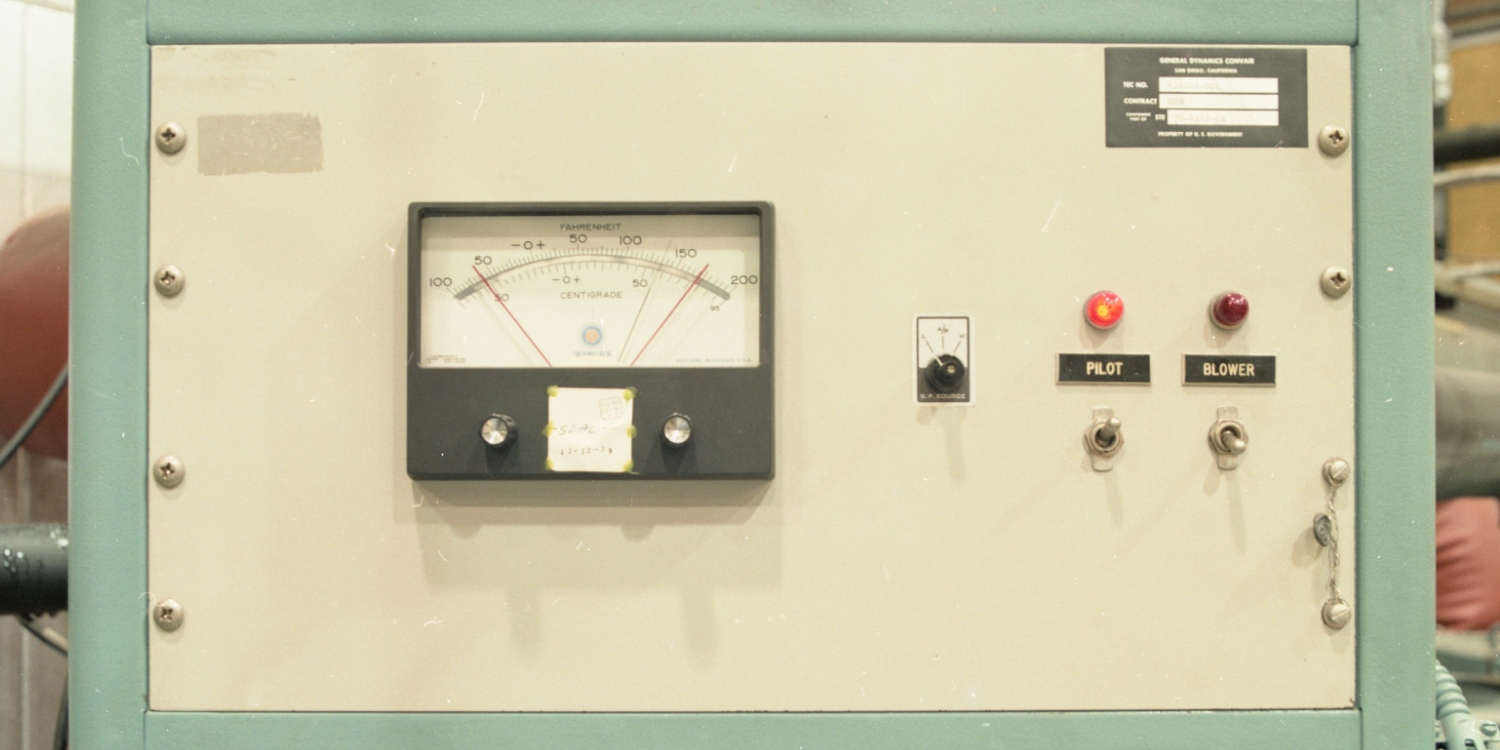
She looked up, and sure enough, the old Honeywell thermostat — filched from some old apartment complex — hung above the living room. One sensor for the entire station. She flinched as if the venomous thing would rear its head and bite her throat.
Her mother walked in. “Oh, Meridith. So lovely. I just can’t get warm tea?”
“MOM!”
Mother said nothing.
“What! What have you done! Good God!”
“I warmed it up. What? I know it’ll be tight next month, with the check, but I just couldn’t keep from having it warm. I’m skin and bones, you know this. Have tea. I can make some bacon.”
Her boss bowed her head: it was the first time the old toad had ever looked ashamed.
“Mom, people are dying downstairs. Dying from freezing to death. Dying because of this.” She pointed to the thermostat.
“Well, they should give out more of these space heaters; it’s just so cold. But these little buddios help me, they do.”
“No, mom, jeez.” Mert pointed up to the ceiling. “You see that?”
“I know it’s such an eyesore, that little brown box; I thought about crocheting a little cover for it.” She was knitting as she shuffled.
“It’s a thermostat, Mom.”
“Oh?”
“It’s the only thermostat here. On the station. Only one.”
“Well, that seems silly. Whole station and just one of those? Who would do something so wrong? But why do you ask?”
“Because the basement—“ and Murder Meridith looked at her mother’s pale frame and all the woman had survived through the war: the loss of sons and husband, the loss of grandsons “—it’s literally freezing.” She spared her the more gruesome details. Mert wasn’t a detective, no. Not a priest. Not a doctor. But maybe the cost of being called Mert just meant that she could face the deaths of the little details so that people like her mom could go on living their cute little lives. Maybe she didn’t bring the death with her when she arrived, but she could still take it with her when she left. She could be Mert, others could live. Maybe she could moralize next time before something got built.
It wasn’t, after all, her mother who did this but the corporation’s enshitification of an entire space station. Maybe she could fix the tiniest detail, the spreadsheets that some folks who knitted doilies preferred to ignore: she could face the deaths caused by bad tallies and cheap parts so that the rest of the warm folks remaining who hated details could rest warm.
Leave a Reply