
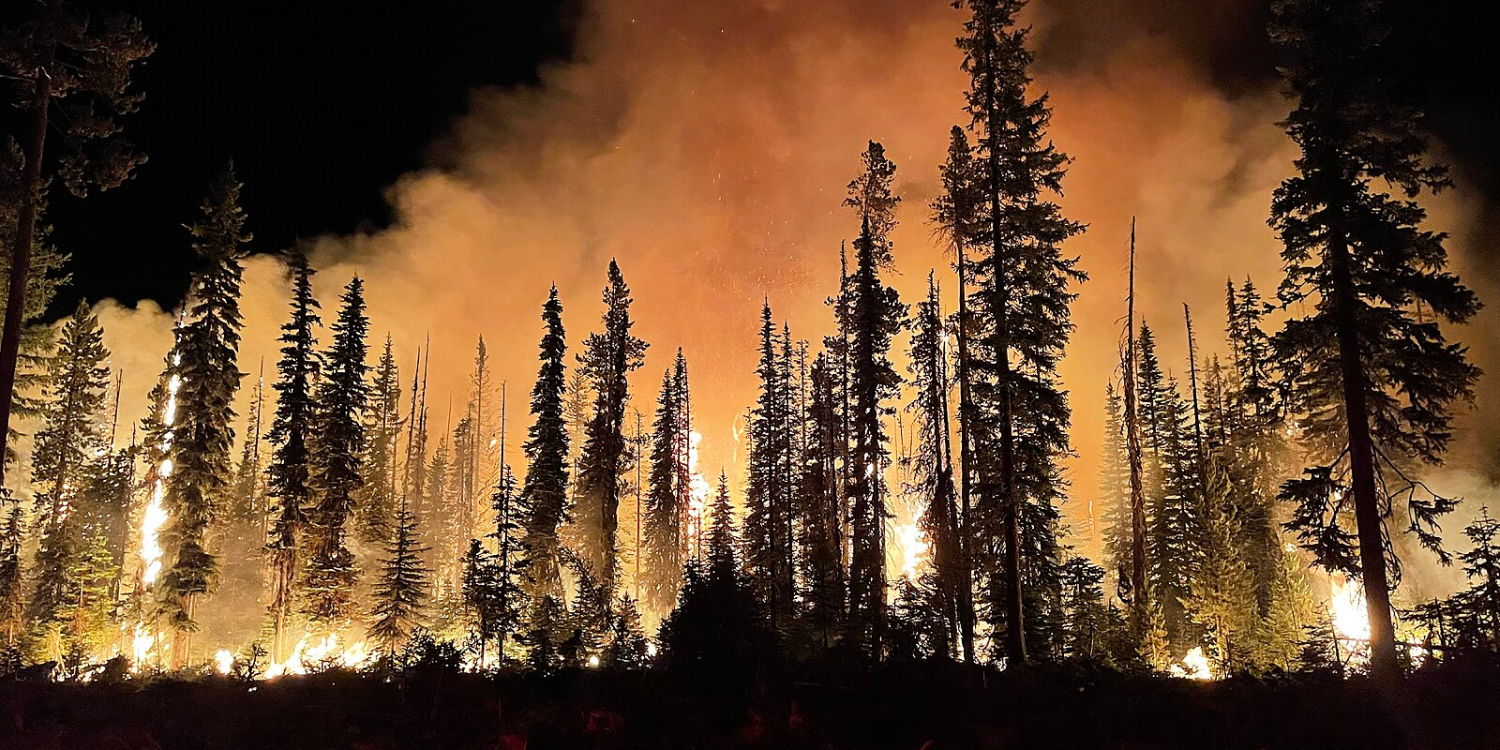
By Mish Gajewski-Zambataro
On Wildfire, year 2353, she flies herself to the Ribbon. Her Saucer — almond-shaped, rainbow-white like a pearl — is gilded by the light of sun-begun-to-set. Earth’s colors streak and meld beneath her like hazel wool through a loom.
She checks her instrumentation, which tells her what she already knows, that she’s drawing very near. Soon, the great spires will appear on the horizon.
Dread in her rises. She hasn’t been to see the spires since childhood, nearly twenty years, yet their image is so clear in her mind — spiraling obelisks, sky-piercing, sharp, black as murk, giant as a cosmic god’s horn.
The spires are supposed to frighten her, she knows. They’re meant to forebode. That’s why they were built. Warnings, augurs of what was and could be again.
Today, Wildfire is a day for celebration — music, dance, and feasting — but foremost, Wildfire is a day for remembrance. For witness. Every year with the approach of Wildfire, as the days shortened and the winds rose, she’d ask herself, Will you go? This year? To the Ribbon? It’s her duty to face the past, but she would imagine the spires, feel that fear, that foreboding, and to her shame, her answer was always, I cannot. Her relatives would go, her neighbors would go, but she would not.
Til’ today.
The brown tones of Earth are changing, becoming greener — she’s entering the Ribbon, the regenerated forest. Endless pine, lush even now at the onset of winter. To see it from the air is to know its full vastness and vibrancy. She feels its beauty fill her, strengthen her. Without the interruption of the spires, she’d never know this was where, never guess this thriving woodland once was dead, scorched, decimated.
That once the Ribbon was a scar.
And here they are.
Black as char, taller than the tallest sequoias, and spaced hundreds of yards apart, the spires jut far over the canopy, laying long shadows upon the Ribbon. They form a snaking line along the hillcrest, continuing north and south out of vision, an imposition on the horizon like the masts of an invading fleet.
Far beyond, visible only as a distant blue glint, is the sea.
Before soaring through the line of the spires, she decelerates, descends between the treetops, coming to a hovering halt a foot off the ground. She climbs smoothly out of the hatch, fills her lungs with fresh air — the Ribbon smells like sap, cold, soil. Like living.
The nearest spire is thirty-some yards from where she stands. It looms dark between the trees, like the blackness of a deep well extracted and stretched into the air. Heart racing, she advances. She’d hoped to find another pilgrim here, but besides the birds whose songs fill the peace, she is alone.
Standing at the base of the spire, she stares into the source of its darkness. Living-Glass encases its liquid interior — a substance black as ink, thick and stagnant. Where it’s struck by light from the lowering sun, it takes on a sickly sheen. She imagines this substance in her throat — choking, heavy, bitter.
It’s the blood of Earth, the fuel, the bounty her ancestors once so rabidly dug for — the Petro.
She kneels beside the spire and looks up its length. She places her hands flat upon its smooth, cold surface.
Contact with the Petro is like a broken chain reforged. History floods her — images of struggle and joy, life and death. Some feel reimagined, like the visuals her mind conjures while listening to a Threader’s story of the past. But others feel reclaimed, as if the forgotten moments of unknown relatives were being remade into memory.
In silence, as the sun sets and the year’s longest night begins, she kneels beside the spire full of Petro, feeling the thread of herself stretch infinitely forward and back, and tries to grasp the memories as they flash.
On Wildfire, year 2303, 50 years before, as on every day of the year, someone must mind the control room, the flow of water through the turbines, the capacity of the solar tiles, the steadiness of the temperature, and the humidity gauges. The greenhouse assemblage is vast, but only as vast as it must be, to grow only what it must grow to feed the People, no more. From the control room, it’s all carefully, easily regulated. From the control-room, a simple balance is maintained — between soil and nutrient, water and plant, production and need.
This year, she’s in the control room. She’s not sad to miss the celebration. She has danced the Memory Fire many times, will dance it again. Has heard the Threader’s story many times and will hear it again. This year, she’s happy to spend Wildfire minding the controls of the greenhouse assemblage instead. Let her serve here today in the place of some relative, as some relative will serve here for her next holiday.
Across the keys of the control board crawls a soldier-beetle. She admires his amber coloring, the vigorous striping of his belly, the rich brown of his spots.
“How did you get in here?” She asks him, scooping him gently into her palm.
She confirms all gauges are stable before exiting the control room. She will return the soldier-beetle to a greenhouse now, place him with the hyssop, where he can enjoy the nectar and, when he comes upon them, eat the little pest-bugs, the little aphids and mites, who’d otherwise harm the crop.
Walking from the control room to the nearest greenhouse, she sees the tips of the spires in the distance.
Black teeth in the horizon’s jaw.
She pauses and nods in their direction. Promises, I won’t ever forget.
Come along, she says to the soldier-beetle, moving forward again. Almost home.
On Wildfire, year 2276, 77 years before, she dances the Memory Fire. She spins with her friend when the horns trill, long skirts flaring. They stomp with the drum. They pass one another to strangers, who hold them sweetly for a reeling orbit around the Fire, then find one another again on the other side. But when the Threader stands to speak, they fall still. They sit and listen.
The Threader thanks the wood that burns in the fire. Thanks the deer and the duck on the platters. Thanks the grain in the bread, and the rice in the pots. May we all give as much as we receive, says the Threader, then tells the story she’s heard many times before, of the first Wildfire, the near-death of Earth, and the coming-together of the People.
It was dark, says the Threader. But we said no more. We stopped forgetting. We said never again. And in the future, a light appeared, and toward it we are walking…
On Wildfire, year 2221, 132 years before, just after sunrise, she is at the control board of a drone equipped with a hook-and-lift mechanism. She maneuvers the drone above the water, lowers the mechanism, and secures it to the target. With a few more movements, she removes the last block from the last dam on the last dammed river in the lands that surround the Ribbon.
Months before, as they reviewed the project’s timeline, they saw that the last day of labor would likely fall on Wildfire.
“We’ll push it back,” said the other engineer.
She disagreed. She said she wanted to finish on Wildfire.
The other engineer laughed and asked, “Don’t feel like joining the revels this year?”
“I do, and next year I will,” she replied. “But what better way to walk toward light in the future than by freeing the rivers from their past, once and for all?”
The other engineer agreed, and they went forward with the project as planned.
She releases this last payload into the pile of debris. When the need arises, these materials will be repurposed or reused, perhaps for new housing, or perhaps to add to the greenhouse assemblage. She’s pleased to think that what once was used to strangle and prohibit might someday be used to nurture and protect.
She pilots the drone back, lands it next to her and the other engineer. The sun, which has just started to lower in the sky, shines beautifully on its crystalline hull, filling its batteries with energy for future projects. This intense light makes visible the intricacy of the drone’s material, its dense network of solar cells, its impenetrable yet supple texture. The People call it Living-Glass. Not for the first time, she is humbled by the brilliance of her ancestors, those who responded to desperation with compassion, to need with ingenuity.
Even now, the People continue to create for the benefit of all. She and the other engineer had spent the morning discussing news from a distant territory: a group has stabilized worker-drones for hypersonic flight, with a reconfigured hull — shaped something like a giant almond — that can comfortably fit a person. A Saucer, they’re calling it, and with it a world, the whole world, of clean, fast, and effortless travel for all may have finally been realized.
She imagines it, piloting not from the ground but from the sky, soaring, Earth blurring hazel below her —
“If we leave now, we’ll be back before the Threader tells his story,” says the other engineer.
She is pulled from her fantasy of the future, returns to today, to this Wildfire. She smiles — she can already hear the throbbing Wildfire drums, taste decadent Wildfire pies, feel the heat of the Memory Fire.
“Let’s go revel,” she says.
On Wildfire, year 2176, 177 years before, she presents her design.
It’s her proposed solution to the great problem they still face. A generation ago, the People defeated the last devotees of Petro, tore down their rigs, dragged to justice their commanders, slew their profiteers. But a question remained, one without a simple answer: What to do with the Petro-worshippers’ terrible surplus? For centuries, they’d hoarded Petro in barrels. Thousands and thousands of barrels. To the bitter end, the last bullet, they’d defended their dangerous stockpiles.
Now, the mass of crude and poisonous Petro idles in these barrels. It’s concealed and inert, but so long as it remains, a peril lingers over the People. So long as it remains, the reign of Petro is not fully ended.
Bury it, some have suggested. Dig deep in the Earth and bury it. But a great wound would be required to bury such a massive amount of Petro. And what if years, decades, centuries from now, the Petro were to leak? To infect the water? That future generation would be poisoned, wide swathes of land robbed of life. So the Petro cannot be buried, and it cannot be burned, nor cleansed, nor launched into space. It cannot be safely transmuted into material. It cannot be used in any way.
What to do with the Petro?
Black spires, she suggests. Placed in a line along the hillcrest, approximating the old fire-scar. We’d honor the tragedy that birthed Wildfire, while making the Petro visible, unmistakable, so we may never forget its darkness.
She presents the specifications. The spires would be made of Living-Glass, impenetrable and resistant to quakes. To minimize wounds to Earth, they’d be buried only deep enough to ensure they couldn’t be toppled. She requests, if her design is chosen, a thorough review by a team of engineers to proof her measurements and plans.
The People can visit the spires on Wildfire, she says. As children, and again as adults. A pilgrimage of sorts. Against forgetting.
The People’s Council on Petro Quarantine listens and, when she has finished, they vote.
They say, “We hesitate to further mark ourselves upon the land, but we cannot be allowed to forget.”
Her design is approved. Construction will begin come spring.
On Wildfire — on what the People, but not yet all people, call Wildfire — in the year 2116, 237 years before, she watches the silent approach of a swarm of big-bellied freighters. Around them buzz fifteen attack-drones. It’s a raiding party sent by the Petro-drinkers out East.
Fat skeeters seeking blood, she thinks.
The freighters’ holds, should they reach their target, will be filled with precious freshwater from the People’s reservoirs. Once filled, the freighters will escape with the People’s water back to their strongholds.
But she and her crew will not allow this to happen.
If the Petro-worshippers were thirsty, she would lead them to the reservoir herself. But it is not their people who are thirsty — it’s their machines. Their machines guzzle great fortunes of water, guzzle still more, and still are not sated.
“Water is for the People,” explained the People’s envoy. “Not your machines. We will no longer tolerate siphoning from our reservoirs.”
The Petro-worshippers, in their cruelty, sent the People’s envoy home without a tongue.
The envoy wrote her a note. It read, “They were warned. Proceed.”
Now she and her crew, hidden between the tall trees of the Ribbon, draw their weapons, open fire at the freighters. The fifteen attack-drones break off, strafe their way. Her radar indicates they’ve been locked on.
She yells to her crew to maintain fire, and they do, drawing the attack-drones closer, closer, past the point of no return. Now the attack-drones won’t make it back to the freighters in time. The People’s drones — rebuilt from the detritus of past raiding parties, remade using the People’s new material — rise up rapidly between the freighters. Forged from Living-Glass — impenetrable, undefeatable — the People’s drone pilots fly them through the freighter’s big bellies. They pierce and come out clean on the other side.
The freighters are falling from the sky.
It’s a battle that will recur, recur, recur til the Petro-worshippers no longer send raiding parties to siphon the People’s water, til all their drones and guzzling machines have been destroyed.
That time is coming, when she can spend her Wildfire feasting and dancing and making music on her horn, spend it listening to Threaders’ stories, not here in the bullet-strewn and bloodied Ribbon.
That time is coming. But for now, she fights.
On Wildfire, year 2070, 283 years before, from a high point in the hills over the reservoirs, she looks out across the old fire-scar. It’s much healed, though the harm it once endured is still evident. It will continue to heal, become greener, lusher, til it’s no longer a scar, because now the People are its stewards. After years of protest — often erupting into violence — she and the People wrenched control of the land back from those who would not cease in the devastation of it — the bosses and profiteers.
The People said, “Our focus must be on restoration and continuance, never again on profit.”
It’d been a great victory for the People, yet the Petro-bosses still own so much. Still sway so many. They still send their clever sorties stealing water.
There’s so much left to do, she thinks. The weight of it all spins her head, makes her struggle for air, but she carries it. She can’t set it down, not yet. It’s still hers to walk with for a while.
She hears footsteps and turns. Her friend is climbing the hill to join her. He wears a patch on one eye where he took a tear-gas cannister to the face years back. He’s left the small celebration taking place in the camp, their simple winter revel. Make music with whatever instruments you have. Cook good food with whatever ingredients you can get. Don’t blink at the darkness of today, dream of the brightness of tomorrow. It’s a sweet tradition passed down to them from the previous — the earliest — generations of the People. They call it Wildfire, but who knows if the name will catch on. It’s just a good reason to dance through the year’s longest night.
Her friend looks out, sees what she’s been seeing, and says aloud what she’s been thinking.
“Almost healed,” he says. “A scar no longer.”
She nods. Says, “Looks more like a Ribbon than a scar.”
On Wildfire, year 2044, 309 years before, she is marching with a great collection of the People. They’re marching to the gates of the bosses, shouting No more, no more, leave the oil on the floor.
The People are not armed, but from beyond the gates comes the sound of rapid fire, pours a sudden flurry of bullets.
Live rounds.
The People cry out, are bleeding. They scatter.
She is struck in the arm — she’s lucky it’s only this. She escapes into the sparse woodland — her slow-healing fire scar home, what the bosses declared uninhabitable. She performs her own first-aid, removes her own bullet, and staunches her own bleeding. Wound bandaged, she seeks the others.
They count their dead, mourn their losses. They regroup. Prepare to march again.
She says, “They’ve got guns. Shouldn’t we?”
On Wildfire, during the wildfire, year 2025, 328 years before, long before it’s called Wildfire, she is born. She is born in a hotel lobby because an ambulance can’t make it to them, and their car’s been burnt up, and mama’s bursting, can’t make it back to their room, can just barely make it to the carpeted alcove where, in normal times, folks sit on threadbare chairs awaiting rideshares and deliveries of fast food.
She comes out quiet into the world. Her parents believe she is stillborn, but a grey-haired lady comes from behind the check-in counter and slaps her gooey red back til she starts to cough. She lives, and her first breath is full of smoke.
Her parents escape the burning-down city with her and, for nearly a year, they live in a series of shelters and motels. When they’re finally allowed to return, there’s nothing left. The land where her parents’ house once stood is beyond a barricade, under redevelopment. They receive a small payout and leave again, nowhere to go.
Some years later, that land becomes a chemical plant, producing a large amount of fire-suppressants. They say this represents some good coming from tragedy, some justice, but she can’t help but wonder if real good, real justice, would amount to more than suppression. She wonders if they’re digging a deeper grave, using oil-reliant methods to solve problems caused by oil.
She wonders what else the world could look like and has a vision of something lush.
She looks at Earth between her feet and sees a small brown cone. She takes it home and plants it.
On her nineteenth birthday, the nineteenth anniversary of the wildfire, of Wildfire-not-yet-Wildfire, she takes the cone, then a sapling, an infant ponderosa, through the barricades that surround the chemical plant. She finds the safest place she can, plants the sapling, wishes it luck, and sneaks back past the barricades.
It’s a long walk back to camp through the fire-scar. Scrub grows everywhere, but the tall trees are gone. The land is parched and pale.
A cough — her weak lungs, the exertion — hits her halfway home. She stops to rest, to breathe. She’s grateful this year, at least, there is no active fire in the area, as there so often is when the days shorten and the winds rise. She looks around at the brown and brittle vegetation that surrounds her, this perfect tinder for the next inevitable conflagration.
She remembers her vision of something lush. She makes a choice.
Active fire or not, she chooses to call today — this day, her birthday, the shortest day of the year — Wildfire. That long-ago devastation’s still alive in her, still scratches her lungs, so why should she let it slip away from memory? Why should she allow the event to fade, become the past, along with every put-down protest and unelected change agent and new green deal and arrested visionary? Today is Wildfire now. A day to peer into the dark, seek light.
Wildfire starts in her smoke-filled lungs. She carries Wildfire home to camp and tells it to the People there —
— it catches.
Leave a Reply